

The Gift of Time: AI, Automation, and the Future of Work in a Time-Rich Economy
This is a peer-reviewed article published by The Digital Economist.
Picture a world where the most valued currency is not money. The digital economy stands on the verge of a powerful transformation, fueled by intelligent systems that deliver the ultimate gift: human time. Tasks that once required days, weeks, or even years of human effort are now done in minutes or seconds, allowing us to enjoy creativity, connection, and well-being in ways we never thought before.
This change affects how we live and what we think work is. It gives a new meaning to how value is made and asks societies to lead an economy in which smart systems perform essential work. As AI transforms the digital world from a labor shortage to a time surplus, those who use time as a strategic asset can achieve greater advances.
This paper examines how AI is revitalizing work, simplifying everyday tasks, saving vast amounts of human time, and driving a shift in society from exhaustion to the promise of a "time dividend,” which is the basis for happiness and getting things done, and makes us think again about what we can do in our lives.
The paper provides examples, such as Citigroup’s 100,000 hours saved per week through its AI adoption, to illustrate the effects of the emerging time-rich organization framework. This idea shows how technological advancements are reshaping the job landscape and the importance of addressing the challenges and opportunities of reskilling and inclusive transitions. Ultimately, the paper argues that work in a time-rich economy will depend on how people, organizations, and societies adapt to and govern the allocation and use of human time.
From exhaustion to time dividend
For many knowledge workers in the pre-AI era, professional success required continuous travel, long hours at client sites, evening studies, and regular sacrifices of their downtime, personal life, and health habits. Translation required human interpreters, cultural adaptation required repeated onsite visits, and follow-up depended on manual note-taking and reporting. Today, real-time translation, context-aware presentation tools, automated documentation, and virtual collaboration reduce the mental and physical effort required while still allowing organizations and their clients to achieve desired outcomes.
This shift suggests the start of what can be called the time dividend. Programmers who use AI-assisted coding tools deliver software significantly faster (Kalliamvakou 2024). Attorneys who use AI for document review say they save double-digit hours each week (Thomson Reuters 2025). Marketers who rely on AI to understand what content is useful spend a good deal less time on initial research (Lee 2024). In each case, AI gives people time for strategic thinking, creativity, relationships, health, and rest.
Research in psychology on “time dividend” shows that when people feel they have enough spare time, it genuinely makes them happier, healthier, and more likely to do good things for others, even when material income is held constant (Kasser & Sheldon, 2008; Whillans, 2020).
The compression of work
A consistent trend is visible in many areas. Processes that previously required a year have been compressed to a month. Workflows that took a month can be compressed to a week. Activities that filled a week are compressed into a day. Routines that filled a day compressed to seconds.
Citigroup is a good corporate example of how AI creates time dividend to professionals while notably increasing earnings. The bank has trained nearly 180,000 of its staff across 83 countries to use AI tools. These include automatic code review, data analysis, and content creation, and have already seen seven million uses in a single year. CEO Jane Fraser said on the Q3 2025 earnings call that these tools now give back 100,000 hours of developer time each week(Reuters 2025).
Citi’s own research anticipates that AI will raise global banking profits by $170 billion (9%) by 2028, reducing regular working hours to minutes, so that engineers and product groups can concentrate on system design, security, and customer innovation, which drives this growth (Citigroup 2024). An internal document stated that AI is “making work that used to take hours into tasks done in minutes” and signaling “the start of a new way of working” (Davis 2025).
The transformation of traffic management in São Paulo offers an urban-scale example. In the 1960s, traffic police stood at road junctions and used hand signals and whistles to direct traffic of cars, buses, and pedestrians. When the city grew to over ten million people, this caused serious congestion and long journeys even for short distances, even using electronic semaphores. The current AI traffic management system uses sensors, cameras, and signal timing to adjust and improve traffic flow. A journey that used to take about an hour for two miles in busy periods now takes approximately fifteen minutes. The city benefits from reduced fuel use, fewer accidents, lower pollution, and millions of hours of commuter time saved (World Bank Group 2023).
There are many other examples. Mount Sinai Health System reduced emergency room wait times by 50% through AI models that forecast patient admissions based on local events and weather forecasts, resulting in faster admissions, fewer holdups, and better use of beds and staff (Dezyit 2025). Doctors and nurses now spend more time on direct patient care, including triage and treatment, rather than managing queues. AI also offers real-time decision support by highlighting risks early, helping doctors prioritize difficult cases.
Amazon’s AI‑driven logistics (predictive inventory stocking, real‑time route optimization, and warehouse robots) delivered over 13 billion items same- or next-day in 2025 alone, up from two‑day shipping, which was revolutionary in 2005. Prime subscribers now save an average of 51 minutes per order and get back hours previously lost to watching for and tracking packages, time now available for family, work, and life (Amazon News 2026).
Shifting structures of employment
Previous periods of technological development markedly altered the nature of employment. In farming and manufacturing, machines reduced the demand for manual labor. Digital technologies re-shaped office work, the provision of supplies, and service industries. With these changes, many jobs were eliminated, though new ones were created. Since the year 2000, manufacturing in a few of the more developed nations has shed approximately 1.7 million jobs, and worldwide, it is thought that automation eliminated roughly 75 million positions by 2022 (TeamStage 2024; World Economic Forum 2024).
In parallel, technology has created about 133 million new jobs in fields that did not exist in 1940, including many digital and knowledge work. Forecasts for the next 10 years indicate that between 400 and 800 million people globally may need to change jobs or acquire new skills by 2030 as automation advances (Batra et al. 2017).
Recent calculations show that even with significant job losses, job creation will often exceed them. For example, the World Economic Forum predicts 170 million new jobs and 92 million displaced workers across the economies studied by 2030, resulting in a net gain of 78 million jobs (World Economic Forum 2025). The biggest challenge isn't just the number of jobs but how quickly and broadly the shift occurs.
AI as an intelligence partner
Earlier technological advancements enhanced physical power. Today’s AI extends cognitive capabilities and continuously improves its own performance. Systems can compose emails, summarize complex information, schedule meetings, create first drafts of products, and handle paperwork. As a result, people at work are relieved of many routine duties and administrative tasks, freeing up hundreds of hours each year (Kurzweil 2024; Dilmegani & Ermut 2025).
Some experts predict that AI and robotics could eventually handle up to 99% of tasks currently performed by paid workers (Burleigh 2025). AI systems are increasingly assisting with research, design, medical diagnosis, legal analysis, and financial modeling, while humans focus on setting objectives, defining constraints, choosing values, and managing tradeoffs. Work shifts from what one must do to live to what one wants to do to make a difference, driven by personal curiosity.
In such an environment, human judgment still plays a vital role. People decide which problems matter, which risks are acceptable, and which tradeoffs are preferable. AI accelerates the search for answers, offers options, and manages many stages. The relationship becomes a collaboration rather than one in which one replaces the other.
As AI transforms the workplace, competitiveness will depend on how well human and machine strengths work together. The “Human Advantage” report presents this as a financial necessity: investing in “stronger brains” to protect brain health and develop skills such as judgment, creativity, and relationship-building that AI cannot replace (McKinsey, World Economic Forum, 2026).
Two time-rich futures
As people gain more free time due to advancements in AI, two distinct societal paths become clear. First, this time is used to enhance learning, foster creativity, boost community engagement, and support personal development. Institutions encourage curiosity, self-awareness, critical thinking, and a sense of life’s purpose. Individuals put more effort into their relationships with others, their involvement in public life, and their contemplation of questions about significance, beauty, and fairness that cannot be answered by simple calculation.
On the other hand, a substantial share of the time AI makes available is spent in digital environments designed to capture attention and deliver short-term rewards (Wang & Wang 2025). Social media, video platforms, and immersive virtual realities give pastimes that are appealing, responsive, and constantly on offer (Clark & Zack 2023). Young people and adults occasionally find it easier to live in these spaces than in real-world groups, particularly when avatars allow them to escape judgment or social limitations (Middleton, 2025). The structure of these systems often supports prolonged use, regular returns, and prizes that favor continued screen time (World Health Organization 2024).
An account of a child whose life increasingly revolves around online games demonstrates the power of these developments. Playing at night, diminished family interaction, and a strong emotional attachment to virtual achievements show how easily digital hobbies can take over. The question is less about the existence of such environments and more about how design, education, and regulation will influence their role in life with more free time.
The reskilling divide and time
The reskilling divide is both an educational and a time issue. People with financial flexibility and free time can enroll in classes, explore different jobs, and gradually transition into expanding sectors of the economy. However, those under constant time pressure from multiple jobs, caring for family, or illness find it difficult to make time for learning, even when courses are available (Human Act 2025).
Recent research on higher education shows that students experiencing severe time poverty earn fewer credits and are much more likely to drop out, partly because they must sacrifice sleep, health, and social connections to meet academic demands (Wadlis 2024). Recent analyses also show that people in low-wage or unstable jobs often lack predictable schedules, making it hard for them to participate in training programs designed to help them adapt to AI. This structural time constraint worsens the reskilling gap (Li, Henry, Manyika, 2020).
The arrival of AI adds another layer. People who understand AI tools and are confident in using them can increase their productivity and adaptability (World Economic Forum 2025). Others may view AI mainly as an external influence that changes expectations without offering clear ways to get involved.
The World Economic Forum estimates that 59 of 100 workers will need substantial training by 2030 to remain useful in their jobs or move into new ones. Of these, 29 can be retrained in their current jobs, and 19 can be assigned new jobs within the company. The other 11 are at increasing risk of being left out if they do not receive enough help (World Economic Forum 2025). This finding highlights a reskilling divide alongside differences in traditional income and wealth.
Narrowing this divide requires organizations, governments, and communities to treat time as a key resource in upskilling and reskilling strategies (Nitzberg & Zysman, 2024). Employers can allocate dedicated learning time, supported by AI-guided curricula and coaching. Governments can promote portable learning accounts and community learning centers. AI itself can function as a tutor for both basic skills and advanced topics, making high-quality instruction widely accessible (Joshi 2025).
Proposals for retraining and learning accounts, funded jointly by employers and the public sector, offer a practical way to give workers both the financial and time resources needed to reskill in an AI-driven economy (West 2025).
From a financial standpoint, investing in reskilling and learning aligns with the idea that demonstrates how ethical AI provides a return (Bevilacqua et al. 2025). Organizations that support their workforce during AI transitions protect their reputations, reduce regulatory risks, and sustain their long-term capacity to innovate (Upmann 2025). Those who cut such investments may save costs in the short term but could later face backlash and restrictions that limit their ability to use AI safely and creatively (PwC 2025).
Governance, ethics, and the economics of time
Assessments of AI investments typically focus on immediate financial benefits, such as revenue growth, cost savings, and increased effectiveness. Newer approaches in AI governance and principles also include reducing risk, complying with regulations, and intangible benefits such as reliability and brand strength (PWC 2025). A comprehensive financial analysis of AI should also consider how AI systems change how time is used.
Future AI ROI plans can include specific calculations of time returned to people at work, customers, and the public. For example, this could include hours saved on travel through smart mobility, hours saved on routine paperwork thanks to AI agents, or hours gained for caring for others and learning because of automated homework. Using these figures, leaders can evaluate projects based on the money they generate, their impact on people’s lives, and their growth potential.
Laws being developed, such as the EU’s AI Act, address risk levels, human oversight, and the effects of high-risk systems (European Commission 2024). These approaches give companies reasons to adopt AI governance, which involves transparency, accountability, and consideration of social and ecological impacts. Including time-based outcomes in these studies will further align AI use with what society ultimately prioritizes.
Organizational governance also evolves as AI agents are integrated into operational structures. AI systems assist customers, serve as analysts, ensure compliance, and support new staff members. Companies must establish clear rules for how these AI agents operate, which decisions require human oversight, and how to evaluate performance. They also need strategies to make sure that the time AI frees up for people at work results in better jobs and meaningful work, rather than just more tasks (Carter 2025).
The time-rich organization framework
A “time-rich organization” framework begins with the premise that time is a strategic asset that should be developed and managed. As AI and automation cut down the time needed for routine tasks to minutes, the key question for leaders shifts from “How can we maximize people’s time?” to “How can we give back time to people in a way that allows them to think, learn, and contribute more meaningfully?”
A time-rich organization treats the time dividend created by intelligent systems as carefully as money, asking who gains more time, who falls short, and how the reclaimed time is used for creativity, learning, connections, and health.
In practice, a time-rich organization adjusts work so that the time dividend is something people actually experience, rather than just something it talks about. Leaders assess how tasks are done, meetings, reports, and digital workflows, and ask one key question: Does this absolutely require people to rely on their own judgment and relationships, or can AI assist or take over so people can reclaim time?
The goal is to increase efficiency and ease constant pressure while protecting key times for deep work, reflection, and reskilling. Policies like scheduling dedicated learning hours, setting aside time without meetings, using AI for administrative tasks, and establishing clear availability standards help ensure that the time freed by automation isn't quietly filled with trivial tasks.
Looking at the bigger picture, a time-rich organization extends this idea beyond itself to its network and society. It measures and shares the time it gives back to employees, customers, and communities as a key success metric, alongside financial and environmental measures, as Citigroup did. When it introduces AI into customer service, distribution, or product design, it considers how these systems affect people’s time: Do customers gain hours of easier access? Do partners have time to develop new ideas? Do local communities benefit from shorter commutes or fewer administrative tasks?
By seeing time as something everyone shares and planning AI deployments to increase time abundance rather than worsen time scarcity, a time-rich organization becomes a force for a healthier, fairer, and more human-centered digital economy.
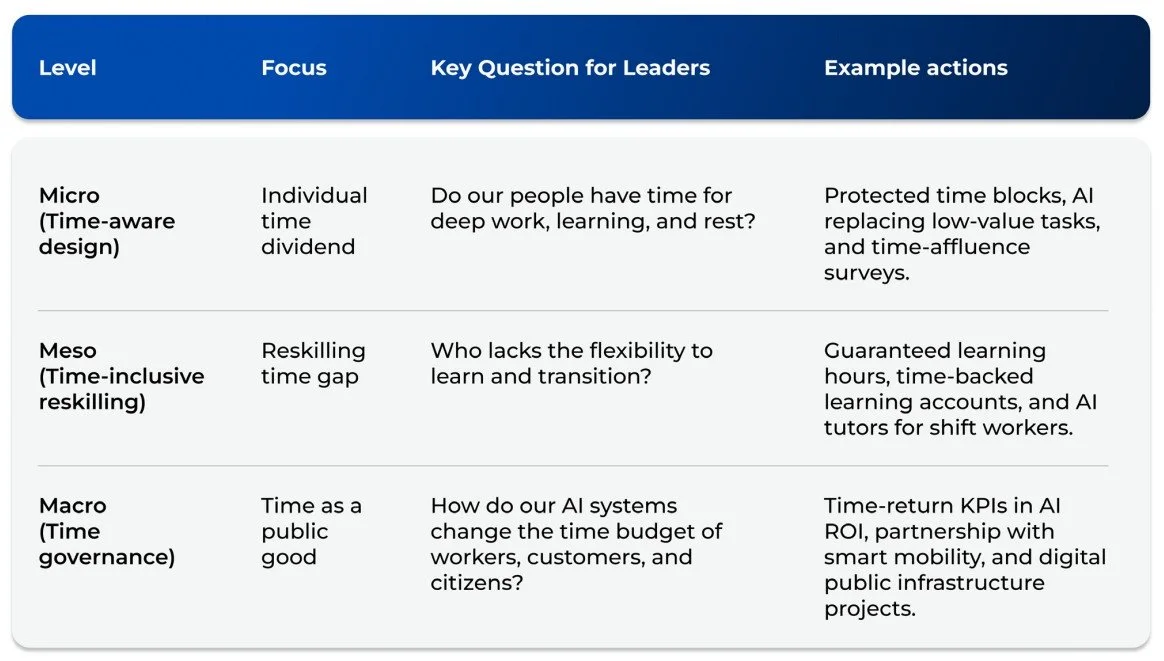
To implement these ideas, organizations can use well-designed systems to guide the effective use of time-rich methods at various levels. The chart below illustrates how leaders can manage time as a valuable resource by applying specific actions and key questions to ensure that having enough time becomes part of how people work, improve their skills, and the organization functions. This framework provides a plan to translate a time-rich organization’s vision into measurable results.
The time paradox: reclaimed time at risk
Individuals and organizations are reclaiming time through the efficient use of AI. However, recent studies from 2026 reveal an irony: AI saves hours each week, yet most workers simply take on more tasks.
An eight-month UC Berkeley Haas study tracked 200 tech employees at a Fortune 500 firm (Counts 2026). Those using AI tools worked faster, completing routine coding and analysis in half the time, but then expanded their scope. They grabbed cross-team projects, multitasked with AI outputs during meetings, and prompted over lunch or in the evenings, creating what researchers branded an "infinite workday." It felt like exciting momentum at first, but months later, unsustainable constant motion for humans and machines alike emerged (Ranganathan, Xingqi 2026).
This pattern validates the earlier governance warning: organizations need strategies to ensure AI-free time yields better work and a role redesign. Literature attributes the cause to design gaps rather than to the individual mindset. Without guardrails, such as protected focus blocks, no-meeting days, or metrics tracking actual time dividend, humans default to familiar busyness.
Boston Consulting Group (BCG) data show that only one-third of firms guide time reallocation, while the rest watch productivity rise alongside burnout (Beauchene et al., 2025). BCG's 10/20/70 principle reinforces human leadership here: AI implementation success demands 10% algorithms, 20% technology, and 70% people/process changes, such as reskilling, adoption of new rituals, and cultural shifts (Gauger et al. 2024). Neglect the human’s 70% impact, and the technical advancements are meaningless.
The time-rich organization framework breaks this cycle. At the micro level, policies like AI-handled admin and scheduled deep-work hours block creep. Meso-level guaranteed learning slots redirect capacity. Macro-level time-return KPIs measure well-being gained rather than tasks completed. Time-dividend research confirms that structured free time boosts health and prosocial behavior; left unstructured, it evaporates. Absent deliberate design and AI's dividend risks dissipation. On the other hand, with deliberate design, technology finally serves human flourishing (Counts 2026).
Systemic and continuous adaptation and public time returns
The transformation in how São Paulo manages its traffic shows how AI can restore people's time as a public benefit. When commuting takes less time, individuals gain hours they can use for relaxation, exercise, time with family, learning, or starting a business. Research links long commutes to lower life satisfaction, poorer health, and less physical activity, indicating that every minute saved through improved, smarter mobility could lead to better health and a higher quality of life (Han, Peng, Xu 2022). When this happens on a large scale, it affects public health, educational outcomes, and civic engagement. The same potential exists in energy systems, healthcare, services, and public infrastructure.
Investments in AI-enabled public systems can enhance AI deployments in businesses. A strong foundation of digital public systems for transportation, payments, identity, and service access reduces friction and saves time in all transactions. In regions that develop these systems with fairness and ethics in mind, AI improves the quality of life and opportunities.
The patterns seen at Citigroup, São Paulo, Mount Sinai Health System, Amazon, and similar contexts reveal how human roles can evolve. Workers move from directly managing processes to supervising, designing, maintaining, and understanding complex systems. New expertise develops from combining knowledge of a specific subject, data, and ethical reasoning. With proper support, many individuals can transition into these roles. Without support, some may find themselves left out.
Educators of the time-rich society: bridging the pace gap with corporations
Today's corporations are rapidly advancing, leveraging AI and other technologies to transform industries, streamline operations, and unlock new efficiencies at a remarkable pace. In stark contrast, education systems, constrained by tradition, regulations, and limited resources, tend to adapt much more slowly, even though they are responsible for preparing future generations to succeed in an increasingly AI-enhanced world.
This discrepancy presents a significant challenge: companies are already benefiting from AI developments that save time, but school systems must provide students with both the technical knowledge and personal skills that enable them to thrive amid constant change, such as adaptability, resilience, continuous learning, comfort with uncertainty, creativity, emotional regulation, collaboration, critical thinking, ethical judgment, inquiry, self-direction, and the ability to find meaning in experience (Twani 2021). New research on “brain capital” refers to these brain skills and shows they are becoming increasingly important for productivity, innovation, and inclusive growth in the age of AI (McKinsey, World Economic Forum 2026).
The speed gap risks leaving graduates unprepared for the realities of tomorrow’s workplace, where the ability to use new technologies and make meaningful use of free time will be essential (Twani 2026). However, the rapid pace of business change serves as both an example and a reason for education reform. Both businesses and education systems benefit from reducing this gap. Their collaboration can ensure that society reaps the full benefits of the time dividend that AI promises, and that human potential is not left behind by technological progress.
What education systems can do:
• Accelerate innovation in learning by adopting flexible approaches, piloting new learning technologies and pedagogies that reflect the adaptability of business.
• Emphasize technical proficiency with AI, but most of all, the unique human skills that technology cannot replace.
• Create flexible learning environments where students can practice making choices about technology use, time management, and collaboration, mirroring the dynamic nature of modern workplaces.
What corporations can do:
• Support educational innovation through funding and sharing expertise, mentorship, and real-world project opportunities that connect the classroom and the workplace.
• Invest in continuous staff training, recognizing that the fast pace of change requires lifelong learning and upskilling for all employees.
• Promote the importance of time as a resource by adopting measures of success that focus on employee well-being, creativity, and meaningful work, rather than just productivity.
Conclusion
As AI continues to shape what is possible in both work and life, the true measure of progress will be how effectively we use the resulting time dividend to foster well-being, creativity, and lifelong learning. The future will favor individuals and organizations that choose to invest this new time not just in economic output, but in learning, innovation, and meaningful human relationships.
AI offers a rare combination: rising productivity and the prospect of deeper human flourishing. Realizing this promise depends on treating time as a strategic resource and on designing roles, systems, and cultures that cultivate human judgment, character, and capacity across every sector of society.
The choices we make in this decade about how we learn, how we work, and what we count as success will shape whether the time dividend becomes a shared foundation for a more humane economy. In the end, those who thrive in the age of AI will be the ones who treat time as their most valuable asset and who design, protect, and share its use so that people and societies can flourish.
References
Kasser, T., & Sheldon, K. M. (2008). Time Dividend as a Path toward Personal Happiness and Ethical Consumption. Journal of Business Ethics.
Giurge, L; Whillans, A.V.; West, C. (2020). Why time poverty matters for individuals, organisations and nations. Nature Human Behaviour Journal.
Kalliamvakou, E. (2024). Research: quantifying GitHub Copilot’s impact on developer productivity and happiness. GitHub Blog.
Future of Professionals Report 2025. Thompson Reuters.
Lee, S. (2024). 10 Stats Revealing AI’s Impact on Content Marketing Success. Number Analytics.
Smart Mobility Program for Sao Paulo. 2023. World Bank Group.
Citigroup's AI usage frees up 100,000 hours for developers a week. (2025). Reuters.
AI in Finance: Bot, Bank, and Beyond. (2024). Citigroup.
Davis, E. (2025). Citi Is Requiring AI Prompt Training for Hundreds of Thousands of Employees. Entrepreneur.
Fleming, S. (2020). A Short Story of Jobs and Automation. World Economic Forum.
How Mount Sinai Uses AI to Reduce Patient Wait Times by 30%. (2025). Dezyit.
Amazon sets new Prime delivery speed record in 2025. (2025). Amazon News.
Job Lost to Automation Statistics in 2024. TeamStage.
Batra, P.; Bughin, J.; Chui, M.; Ko, R.; Lund, S.; Manyika, J.; Sanghvi, S.; Woetzel, L. (2017). Jobs Lost, Jobs Gained: What the Future of Work Will Mean for Jobs, Skills, and Wages. McKinsey Global Institute.
Future of Jobs Report 2025: 78 Million New Job Opportunities by 2030, but Urgent Upskilling Needed to Prepare Workforces (2025). World Economic Forum.
Kurzweil, R. (2024). The Singularity is Nearer: When We Merge with AI. Random House.
Dilmegani, C.; Ermut, S. (2025). When Will AGI/Singularity Happen? 8,590 Predictions Analyzed. AI Multiple.
Burleigh, E. (2025). AI Expert Says It’s ‘Not a Question’ That AI Will Take Over All Jobs – But People Will Have 80 Hours a Week of Free Time.Fortune Magazine.
Wang, J.; Wang, S. (2025). The Emotional Reinforcement Mechanism of and Phased Intervention Strategies for Social Media Addiction. National Library of Medicine.
Clark, L.; Zack, M. (2023). Engineered highs: Reward variability and frequency as potential prerequisites of behavioural addiction. Science Direct.
Teens, screens and mental health. World Health Organization.
Middleton, C. (2025). Online safety – the challenge when children feel safer online than in the physical world. Diginomica.
Twani, E. (2021). Becoming Einstein’s Teacher: Awakening the Genius in Your Students. Relational Learning, Inc.
Twani, E. (2026). Dystopian or Utopian Future.
Perez, L.; Bishen, S. (2026). The Human Advantage: Stronger Brains in the Age of AI. World Economic Forum.
The Future of Jobs Report 2025. World Economic Forum.
Time Poverty: The Rising Cost of Time in an Unequal World. Human Act.
Wadlis, C. (2024). Time poverty impacts college students with jobs and kids, especially for certain groups, a study shows. Fast Company.
Henry, M. K.; Li, F.; Manyika, J. 2020. As AI Shifts Jobs, How Do We Prepare the Workforce?Stanford University Human-Centered AI.
Four Futures for Jobs in the New Economy: AI and Talent in 2030. World Economic Forum.
Nitzberg, M.; Zysman, J. (2024). Generative AI and the Future of Work: Augmentation or Automation? SSRN.
Joshi, S. (2025). The Transformative Role of Agentic GenAI in Shaping Workforce Development and Education in the US. Iconic Research and Engineering Journals.
West, D. M. (2025). Ways to help workers suffering from AI-related job losses. Brookings Institute.
Bevilacqua, M.; Berente, N.; Domin, H.; Goehring, B.; Rossi, F. (2023). The Return on Investment in AI Ethics: A Holistic Framework. Cornell University.
Upmann, P. (2025). The ROI of AI Governance – Why Responsible AI Pays Off. LinkedIn.
Blumenfeld, I.; Gurdeniz, E.; Kosar, J.; Sen, R. (2025). PwC’s 2025 Responsible AI survey: From policy to practice. PwC.
Carter, S.; Et Al. (2025). AI Agents as Employees. The Digital Economist.
Counts, L. (2026). AI promised to free up workers’ time. UC Berkeley Haas researchers found the opposite. UC Berkeley Haas.
Ranganathan, A.; Xingqi, M. Y. (2026). AI Doesn’t Reduce Work—It Intensifies It. Harvard Business Review.
Beauchene, V.; Duranton, S.; Kalra, N.; Martin, D. (2025). AI at Work: Momentum Builds, but Gaps Remain. Boston Consulting Group.
Gauger, C.; Kataeva, N.; Levin, A. 2024. The Stairway to GenAI Impact. Boston Consulting Group.
Han, L.; Peng, C.; Xu, Z. (2022). The Effect of Commuting Time on Quality of Life: Evidence from China. International Journal of Environmental Research and Public Health.